
Most families head out on a bushwalk thinking of it as a break from learning, a chance to stretch legs and burn off some energy before lunch. But there's a whole science curriculum hiding in a fairly ordinary patch of bush, and you don't need a worksheet, a lesson plan, or even much of a plan at all to bring it out. All it really takes is slowing down and asking better questions than "are we there yet."
Here's how a walk like that tends to unfold in our family, broken down by the kind of scientist your kids get to be at each stage.
1. Become Nature Detectives
Start with a challenge before anyone's even properly on the track: how many signs of living things can you find before we reach the first bend? It sounds simple, but it flips a walk from "getting from A to B" into "actually looking," and kids are surprisingly good at spotting things adults walk straight past.
Look for animal tracks, feathers, insect holes, spider webs, chewed leaves, bird nests, droppings, burrows, fallen seeds, fungus, and different types of leaves. Every one of those is evidence of something living its life nearby, and the hunt for them does most of the work of getting kids into observation mode without you having to say the word "science" once.
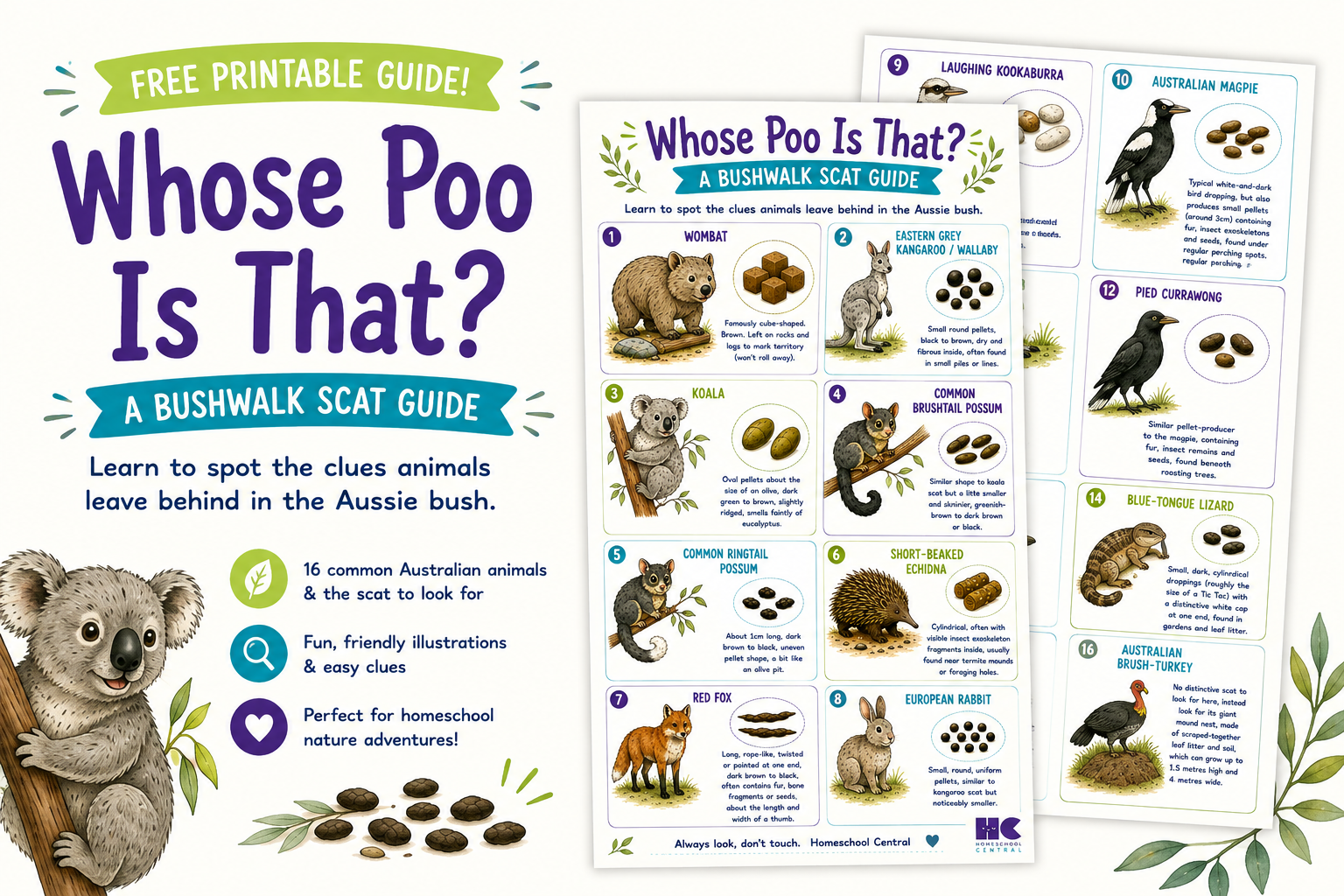
This is a great spot to pull out an animal tracks and scat identification chart.
We've put together our own free printable guide for exactly this, sixteen common Aussie animals, their tracks and their scat, ready to print and take on your next walk.
2. Investigate the Plants
Once everyone's in that noticing headspace, it's worth actually stopping at a plant and looking properly, rather than walking past a hundred of them without really seeing any. Choose three different plants along the track and get close: leaf shape, leaf size, texture, colour, bark, flowers, seeds, height.
The questions that get the best answers out of kids are the ones with no single right answer. Why do you think this leaf is shaped like that? Why might some leaves feel thick or waxy while others are thin and soft? Why is this plant growing in full sun while that one's tucked into the shade? You're not testing them on plant biology, you're getting them to reason like a scientist would, from observation to hypothesis.
A magnifying glass earns its keep here too, since leaf veins, tiny hairs on stems and the texture of bark all reveal a lot more up close than they do at a glance.
3. Go Mini-Beast Hunting
Getting down low is usually the next natural move, and it's the bit most kids love best. Turn over a log, peer under leaf litter, check around the base of a tree trunk, and you'll almost always find something moving: ants, beetles, spiders, worms, slaters, caterpillars, millipedes, flies.
Rather than just naming what you've found, the better question is where you found it, what it seemed to be doing, and what it might eat, and what might eat it in turn. Those two questions are where habitat and food chains sneak in without you ever announcing the topic.
A cheap magnifying glass or bug viewer pot makes a real difference here, small enough to live in the backpack, and it turns "here's an ant" into an actual close-up look at legs, antennae and body segments that the naked eye just can't catch. More on that, including a levelled-up option, down in the resources section below.
4. Look for Food Chains
Once kids start looking properly, they'll notice the bush is full of relationships. Chewed leaves, birds hunting through the undergrowth, insects feeding on flowers, a spider with something caught in its web, seeds being eaten off the ground, it all starts to add up to a much bigger picture than "here's a bug" and "here's a plant."
Ask who eats whom, and challenge your kids to build three food chains out of things they've actually observed that day, rather than ones out of a book. Real evidence makes a far more convincing food chain than an imagined one.
5. Investigate the Trees
Somewhere along the walk, it's worth stopping properly at one big tree and treating it like its own little world, because that's essentially what it is. Ask your kids to become tree scientists for a few minutes: how tall do they reckon it is, how old might it be, is the bark smooth or rough, are there any holes in the trunk, does it have flowers, fruit or seeds right now.
Then widen the question out. What's living on this tree, and what's living underneath it? A single tree can be offering food, shelter, nesting sites, shade, moisture and protection all at once, and the big question worth sitting with is simply how many different living things might depend on this one tree to survive. It's a genuinely good way to introduce the idea of an ecosystem without ever using the word until after they've already worked out the concept themselves.
6. Become Weather Scientists
An open clearing is a good spot to pause and pay attention to something less obvious than plants and bugs: the weather right where you're standing. Record the temperature, cloud cover, wind, rain, humidity and how much sun or shade you're in.
Then compare two locations. Is it cooler under the trees? Windier out in the open? Does the ground feel different underfoot in sunlight compared to shade? What you're actually showing them is a microclimate, the idea that quite different conditions can exist just metres apart within the same environment, and it tends to land better felt on their skin than explained in a sentence.
7. Become Geologists
At some point on almost every walk, it's worth just stopping and looking at what's underfoot rather than what's ahead. Rocks, sand, clay, pebbles, soil, decaying leaves, tangled tree roots, it's all there and it's all telling a story if you ask the right questions.
Why do you think these particular rocks ended up here? Are they smooth or rough, and what might that tell you about how they got that way? What happens to rocks over time, and why does soil matter so much to everything else you've looked at today? It's an easy, unplanned segue into basic geology, and kids tend to find it oddly satisfying to realise the ground itself has a history.
8. Investigate Decomposition
We like to end a bushwalk science session on a single fallen leaf, because it ties everything else together. Find one on the ground and ask what they think will happen to it over the coming months. If you can, find a few leaves at different stages nearby, fresh, browning, breaking down, and almost soil already, so the whole process is laid out in front of them at once.
That's your opening to talk about decomposers: fungi, bacteria, worms, insects and all the other tiny organisms doing the quiet work of breaking things down. Then ask the big closing question: what would happen to the bush if nothing ever decomposed? It's a great discussion about nutrient cycling, and how dead material eventually becomes part of the soil that everything else on this list depends on.
9. Keep a Field Journal
One thing worth building into any of the above is a simple field journal, even just a notebook and a pencil in the bottom of the backpack. Jot down what you found, sketch a leaf or a track, note the date and roughly where you were.
The real value shows up once you start comparing entries from different local areas. A bushwalk on the coast can look and feel completely different from one twenty minutes inland, different plants, different insects, different ground underfoot, even a different microclimate on the same afternoon. Comparing field notes from a few different spots over a term turns individual walks into an ongoing project, and it's a genuinely good way for kids to notice patterns they'd otherwise miss.
Handy Resources
A couple of field guides worth having in the house if this becomes a regular thing for your family:
- A magnifying glass or bug viewer pot is the cheap, no-fuss option and honestly all most families need, small enough to live in a pocket or the bottom of a backpack. For a bigger step up, something like The Miniscope Pro is a handheld digital microscope built specifically for kids, with zoom up to 1000x and a screen so the whole group can see the same find at once rather than passing a tiny lens around. (Not an affiliate link yet, but we're planning to set one up so we can pass on any discount to families.)
- Tracks, Scats and Other Traces: A Field Guide to Australian Mammals by Barbara Triggs is the classic Australian reference for exactly what it sounds like, identifying mammals by the footprints, scats and other signs they leave behind. It's aimed at bushwalkers and naturalists generally rather than written specifically for kids, but it pairs brilliantly with a "nature detective" walk.
- Plantastic! Discover Fantastic Aussie Plants by Cat Clowes and Rachel Gyan (CSIRO Publishing) is written specifically for kids, an A to Z of native plants they might spot in a local park or patch of bushland, and a nice companion to the plant investigation above.
- Seek by iNaturalist is a free, genuinely kid-safe app worth downloading before your next walk. Point the camera at a plant, bug or fungus and it'll suggest what it might be, no login required and no data collected unless you choose to create an account. None of this needs a worksheet, a checklist, or even much advance planning. The bush is already set up to teach ecology, biology, geology and chemistry in one walk, you just have to slow down enough to notice, and ask the kind of questions that don't have a single right answer.
Homeschool Central is Australia's dedicated platform connecting homeschool, unschool and world school families with local classes, camps, events and providers.